



Grade comparison guide
N35 vs N52 Magnets: Strength, Geometry and Temperature
Direct answer: N52 belongs to a higher nominal maximum-energy-product class than N35, so it can provide more material-level magnetic potential in a controlled comparison. It is not automatically the better finished magnet. Useful field, force, torque, temperature margin, demagnetization resistance, geometry, air gap, steel circuit, supply, cost, and representative validation decide the application result.
What N35 and N52 actually identify
N35 and N52 are NdFeB grade-family labels associated with nominal material-property ranges under defined test conditions. The higher N-number indicates a higher maximum-energy-product class. It does not define one exact recipe, coercivity class, application temperature, coating, tolerance, price, availability, or finished magnetic result.
Use the Neodymium Magnet Grades guide for the broader naming system. Use the exact approved material data for the proposed production route before making a drawing or release decision.
Engineering Evidence · EM-MAG-05 · Revision A
N35-to-N52 decision boundary
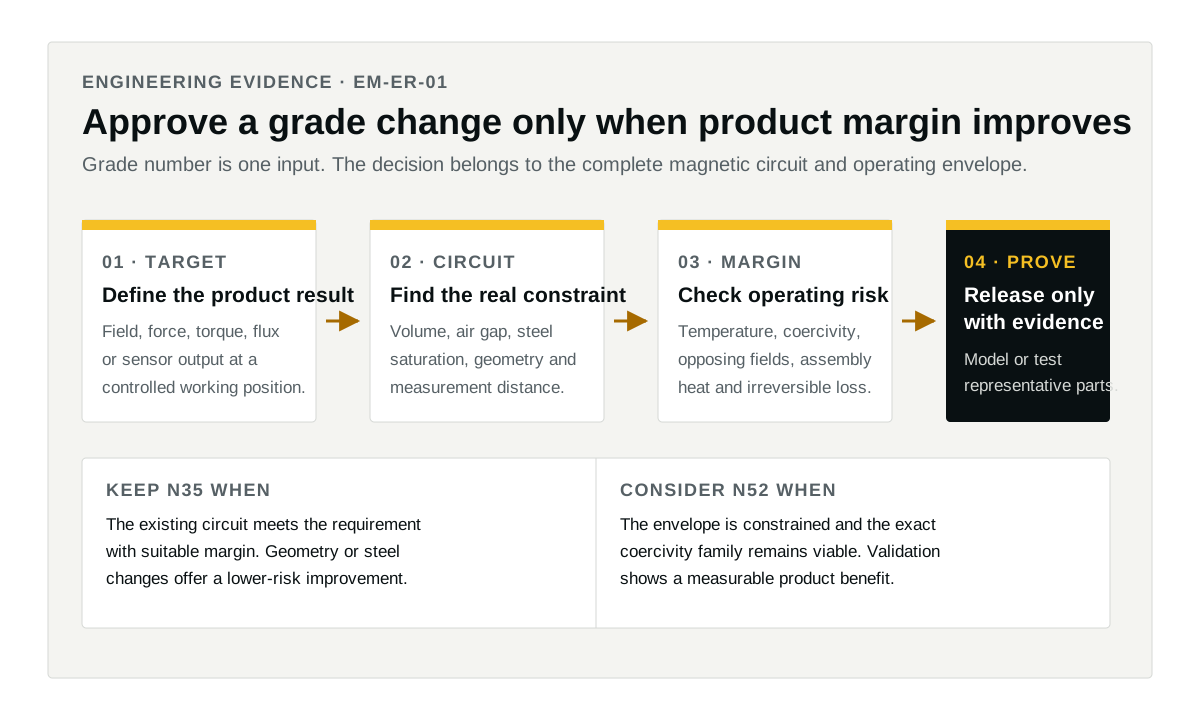
A controlled N52 proposal needs four links: the useful product result that must improve, the circuit constraint preventing a lower-risk geometry solution, adequate coercivity and temperature margin for the exact N52 family, and representative evidence that the change produces a measurable system benefit.
| Decision gate | N35 remains a valid choice when | N52 may be considered when | Release evidence |
|---|---|---|---|
| Product target | The current design meets the defined result with margin | The useful result is short and the envelope is constrained | Same measurement position, temperature, assembly state, and acceptance rule |
| Circuit and geometry | Air gap, return path, leakage, steel, or dimensions offer a lower-risk improvement | Geometry is fixed and analysis shows useful additional material potential | Reviewed drawing, model assumptions, and tolerances |
| Operating margin | The selected coercivity family survives normal and adverse cases | The exact N52 coercivity family also retains the required margin | Approved curves, load line, peak temperature, reverse field, and loss criterion |
| Production and supply | Cost, availability, process stability, and repeat supply favor the current route | Measured benefit justifies qualification and supply implications | Samples, inspection, change control, and commercial comparison |
| Validation | Existing evidence represents the final circuit and duty | Representative tests confirm the predicted product improvement | Prototype or correlated application result and release decision |
N35 and N52 compared as engineering choices
| Question | What to compare | Why the grade number is insufficient |
|---|---|---|
| Will the product output improve? | Field, force, torque, flux, or sensing result at a defined working position | The circuit can be limited by air gap, leakage, steel saturation, geometry, or measurement setup |
| Will demagnetization margin remain adequate? | Coercivity family, load line, knee, reverse field, peak temperature, and allowable irreversible loss | The N-number alone does not state the full demagnetization behavior |
| Can geometry solve the problem? | Magnet length, pole area, return path, air gap, steel, tolerances, and assembly stack | A dimension or circuit change can outperform a material upgrade at lower risk |
| Can the change be supplied repeatedly? | Proposed production route, availability, process stability, inspection, cost, and change control | A nominal grade label does not define a qualified supply route |
| How will the change be approved? | Model correlation, controlled samples, representative duty, and product-level acceptance | A generic calculator or bench comparison may not represent the final assembly |
Why a same-size comparison can mislead
A same-size N52 magnet can produce a stronger result than N35 in a suitable circuit, but the gain is not a fixed percentage. Force and torque respond nonlinearly to air gap, pole area, return steel, saturation, leakage, magnet length, measurement distance, and the operating point.
A higher material class can also deliver little useful gain if the steel is already saturated, the air gap dominates, the field is measured too far from the working region, or another circuit element is the real constraint.
Temperature suffix and coercivity are separate decisions
The N-number is not a maximum operating-temperature rating. Review the exact coercivity family, demagnetization curve and operating point, continuous and peak temperature, dwell time, geometry, opposing field, assembly heating, and allowable irreversible loss.
An N35 family with a more suitable coercivity and thermal margin can be the more robust engineering choice. An N52 family is valid only when its exact property set and supply route meet the same controlled requirements.
A controlled selection sequence
- Define the useful magnetic result, position, temperature, assembly state, and acceptance rule.
- Record the magnet envelope, air gap, return path, surrounding steel, tolerances, and leakage paths.
- Check whether geometry or circuit changes can meet the target with lower technical and supply risk.
- Compare the exact N35 and N52 coercivity families using approved material data and the same curve convention.
- Review normal and adverse operating points, including peak temperature and opposing fields.
- Include coating, magnetization, assembly sequence, inspection, availability, cost, and change control.
- Validate representative parts or assemblies and release the change against the defined product result.
Information to include in an N35-to-N52 review
- Current grade designation, source, drawing revision, geometry, coating, and magnetization.
- Target field, force, torque, flux, waveform, or sensing result with its measurement method.
- Magnetic circuit, air gap, steel, mechanical interfaces, and assembly state.
- Continuous, peak, assembly, storage, and fault temperatures and dwell times.
- External opposing fields and permitted irreversible change.
- Prototype quantity, annual demand, qualification evidence, and change-control expectations.
Review custom sintered NdFeB magnets, the engineering and DFM process, and the quality and inspection approach. Send the actual circuit and target through the RFQ form when a controlled grade recommendation is needed.
Boundary: exact properties must come from the approved material and production-route data. Finished performance, feasibility, price, MOQ, lead time, and supply choice require the actual drawing, quantity, circuit, operating envelope, and validation plan.
Frequently asked questions
Will changing from N35 to N52 increase force by the same percentage as the grade number?
No. Force or torque changes nonlinearly with geometry, air gap, steel saturation, leakage, working point, and temperature. The complete magnetic circuit must be recalculated or tested.
When can N35 be the better engineering choice?
N35 can be preferable when it already meets output, while offering a more suitable coercivity class, temperature margin, supply position, cost, or manufacturability for the actual design.
Is N52 always stronger than N35 in the same size?
N52 has higher material-level magnetic potential under matched conditions, but the useful difference can be limited by air gap, steel saturation, leakage, geometry, temperature, and measurement position.
Does N52 have a higher operating temperature than N35?
Not from the N-number alone. Compare the exact coercivity family, approved demagnetization curves, geometry, working point, peak temperature, dwell time, opposing fields, and permitted irreversible loss.
What should be sent for an N35-to-N52 review?
Send the current material and drawing, target magnetic result, circuit and air gap, continuous and peak temperatures, adverse fields, assembly state, quantities, qualification requirements, and acceptance method.