



NdFeB fundamentals
What Is a Neodymium Magnet? NdFeB Basics for Engineers
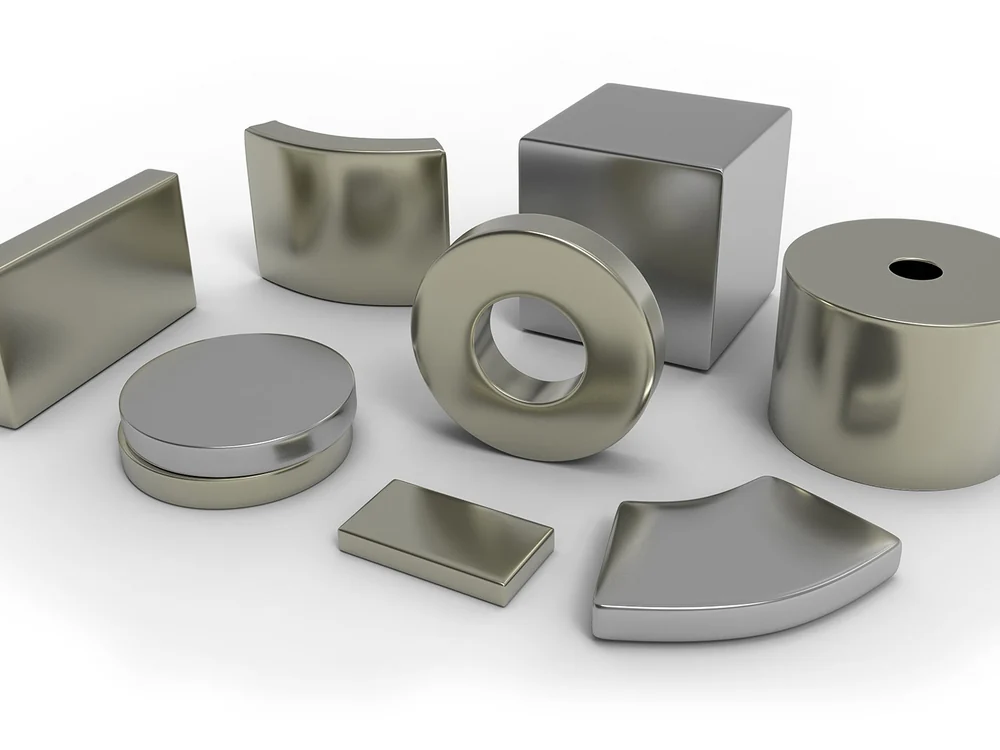
A neodymium magnet is a permanent magnet made from a neodymium-iron-boron alloy system, commonly abbreviated NdFeB. It is valued for high magnetic output relative to its size, but “neodymium magnet” is only the material-family starting point. Finished performance depends on grade, coercivity, geometry, magnetic circuit, temperature, coating, magnetization, assembly and the measurement method.
The definition in one sentence
Neodymium iron boron is a rare-earth permanent-magnet material family. After manufacturing and magnetization, the material can maintain a magnetic field without a continuously powered coil. The name does not mean the magnet is pure neodymium, and it does not identify a single grade, coating, shape, temperature limit or finished force.
NdFeB is often selected when a product needs substantial magnetic performance in a limited volume. That can support compact motors, sensors, actuators, speakers, couplings, holding devices and magnetic assemblies. The correct design still begins with the function and operating conditions, not with the strongest catalog grade.
NdFeB entity and decision map
| Term | What it identifies | What it does not prove | Next project question |
|---|---|---|---|
| Neodymium / NdFeB | A permanent-magnet alloy family based on neodymium, iron and boron. | Finished force, field, torque, temperature capability or corrosion life. | What useful magnetic result is required and where? |
| N-number grade | A nominal maximum-energy-product family in a defined material data source. | That the highest number is the best or safest application choice. | Which coercivity family, operating point and temperature profile apply? |
| Sintered or bonded | A manufacturing or compound route with different density, geometry, tooling and pole-pattern implications. | Universal tolerance, price, output or production feasibility. | Which finished-part route fits the geometry and assembly? |
| Coating | A selected surface-protection system and dimensional layer. | Service life in every humidity, chemical or bonding condition. | What environment, edge condition, adhesive and validation method apply? |
| Magnetization | Direction, polarity or pole pattern created in the part or assembly. | That the useful field appears at the required location. | How are direction, reference, delivery state and inspection defined? |
| Magnetic assembly | The magnet combined with steel, adhesive, sleeve, housing, hub or other components. | That the loose magnet and installed system will measure the same. | What air gap, return path, retention and functional test represent use? |
Why neodymium magnets can be compact
NdFeB is known for high magnetic energy density. In practical product design, that can allow a smaller magnet volume than some alternative material routes for the same target. The advantage is not automatic. Leakage, air gap, surrounding steel, pole geometry, temperature and saturation in the magnetic circuit determine how much of the material potential becomes useful field, force or torque.
A design can reach a point where a higher material grade creates little additional system output because another component limits the circuit. This is why a grade comparison must remain connected to geometry and the full magnetic path.
What a grade name tells you
Grade names such as N35, N42 or N52 group material-property ranges under stated test conditions. Suffixes are commonly used for higher-coercivity or temperature-oriented families. Exact values and availability belong to the approved material data for the proposed production route.
The N-number is not a pull-force rating. A lower grade in a larger or better magnetic circuit can outperform a higher grade in a poor circuit. Review neodymium magnet grades and the focused N35 versus N52 comparison before treating the grade as a finished-product decision.
Temperature and demagnetization
Temperature changes magnetic output, and excessive exposure can create irreversible loss. The risk depends on the grade and coercivity family, geometry, operating point, external opposing fields, exposure time and the permitted change in the finished product.
Assembly heating, fault conditions and storage can be different from normal operation. Include all of them. If a product has already become weaker, use the permanent-magnet strength-loss diagnostic to separate material demagnetization from corrosion, damage, air-gap or measurement changes.
Corrosion, coating and edge protection
Sintered NdFeB normally requires surface protection appropriate to the service environment. Common coating names do not guarantee the same process, thickness, adhesion, edge coverage or service result. Condensation, chemicals, salt exposure, handling damage, adhesive cure and the surrounding housing can change the protection strategy.
Coating also changes dimensions and can affect the air gap or bonding surface. Use the NdFeB coating guide to connect the coating name to the actual environmental and inspection evidence.
Sintered, bonded and assembled NdFeB
Sintered NdFeB and bonded NdFeB are different finished-part routes. A sintered route may be selected for material-level output, while bonded routes may be considered for near-net geometry, integrated features, multipole patterns or assembly handling. Bonded NdFeB itself includes different forming and binder systems.
Changing between these routes is rarely a material-only substitution. The magnet volume, pole architecture, tooling, air gap, steel circuit, assembly and validation plan may all change. See the finished-part route guide for the broader comparison.
Magnetization is part of the product definition
A magnet is useful only when its polarity and field are oriented correctly for the assembly. Axial, diametrical, radial and multipole magnetization change the pole locations, mechanical references, fixtures and inspection paths. “Magnetized” is not a complete drawing instruction.
Define direction, N/S orientation, pole count or pitch, reference feature, viewing direction, delivery state and test position. The magnetization direction guide and drawing specification guide provide the next step.
How NdFeB magnets are used in engineering
- Motors and actuators: torque, efficiency, waveform, rotor retention and temperature must be evaluated together.
- Sensors and encoders: pole position, field shape, air gap and repeatable scan conditions matter more than a generic strength claim.
- Holding and separation: contact condition, steel thickness, surface condition, safety factor and release behavior define the useful result.
- Speakers and voice coils: gap flux, steel saturation, heat and assembly concentricity shape performance.
- Magnetic assemblies: adhesive, sleeves, hubs, housings, balance, corrosion protection and inspection become part of the magnet specification.
Source and evidence boundary
Arnold Magnetic Technologies’ NdFeB material page supports the composition, property relationships, grade-family language and explicit dependence on geometry and alignment used in this guide. Its numeric tables, grade availability, temperature fields and production capabilities are supplier-specific and are not Elite Magnets specifications.
The dated SERP sample showed that definition pages commonly cover composition, history, strength, coating and uses, but often stop before connecting the terms to a controlled magnetic circuit, drawing and acceptance method. EM-NDFEB-02 is an original entity map designed to close that gap.
Information needed before selecting a neodymium magnet
- Required field, flux, force, torque, waveform or sensor signal and its measurement position.
- Available envelope, air gap, surrounding steel and assembly model.
- Continuous, peak, fault, assembly and storage temperature.
- Moisture, chemicals, coating, bonding, cleanliness and handling conditions.
- Geometry, tolerances, datums, edges and finished coated state.
- Magnetization direction, pole pattern, reference and delivery state.
- Prototype quantity, annual volume, validation stage and required inspection records.
Explore custom sintered NdFeB magnets, bonded NdFeB magnets, Custom Capabilities, Quality or send the available inputs through the RFQ form.
Engineering note: “Neodymium magnet” identifies a material family. It does not approve a grade, coating, geometry, magnetization, manufacturing route or finished-product result.
Frequently asked questions
What is a neodymium magnet made of?
A neodymium magnet is based on a neodymium-iron-boron alloy system, abbreviated NdFeB. The finished product may also include a coating, binder, adhesive, steel, or other assembly components.
Is every neodymium magnet an N52 magnet?
No. N52 is one grade family. NdFeB magnets are available in multiple grade and coercivity families selected around magnetic output, temperature, geometry, circuit, availability, and project validation.
Does the N-number tell you the magnet force?
No. The N-number groups a material-property range under defined conditions. Finished force depends on dimensions, air gap, pole area, surrounding steel, working point, temperature, and the test setup.
Why are neodymium magnets usually coated?
Sintered NdFeB commonly uses a selected surface-protection system. Coating choice depends on humidity, chemicals, edge condition, dimensional build, bonding, handling, and the agreed validation method.
What details belong in a custom NdFeB specification?
Include geometry, grade or functional target, temperature and environment, coating, magnetization direction or pole pattern, assembly state, critical dimensions, inspection method, quantities, and revision.