



RFQ preparation
Custom Magnet Drawing Checklist for RFQs
Direct answer: A useful custom magnet drawing identifies material or performance intent, dimensions and functional datums, coating state, magnetization direction, polarity or pole pattern, operating environment, assembly interfaces, critical inspection characteristics, quantities, and revision status. If a decision is still open, mark it clearly and provide the application context instead of inserting an unsupported specification.
The drawing is one part of the engineering package
A magnet can meet its standalone drawing and still fail in the product if the air gap, temperature, surrounding steel, bonding, rotor geometry, sensor position, or assembly sequence is missing. Send enough context to explain what the controlled features protect.
Engineering Evidence · EM-ER-04 · Revision A
Revision-controlled drawing release record
A drawing package is ready for quotation or release when each material, geometry, coating, magnetization, inspection, and commercial decision is either approved, visibly open with an owner and closure evidence, or intentionally not applicable. Completing every field with an unsupported assumption is less controlled than preserving a clearly assigned open question.
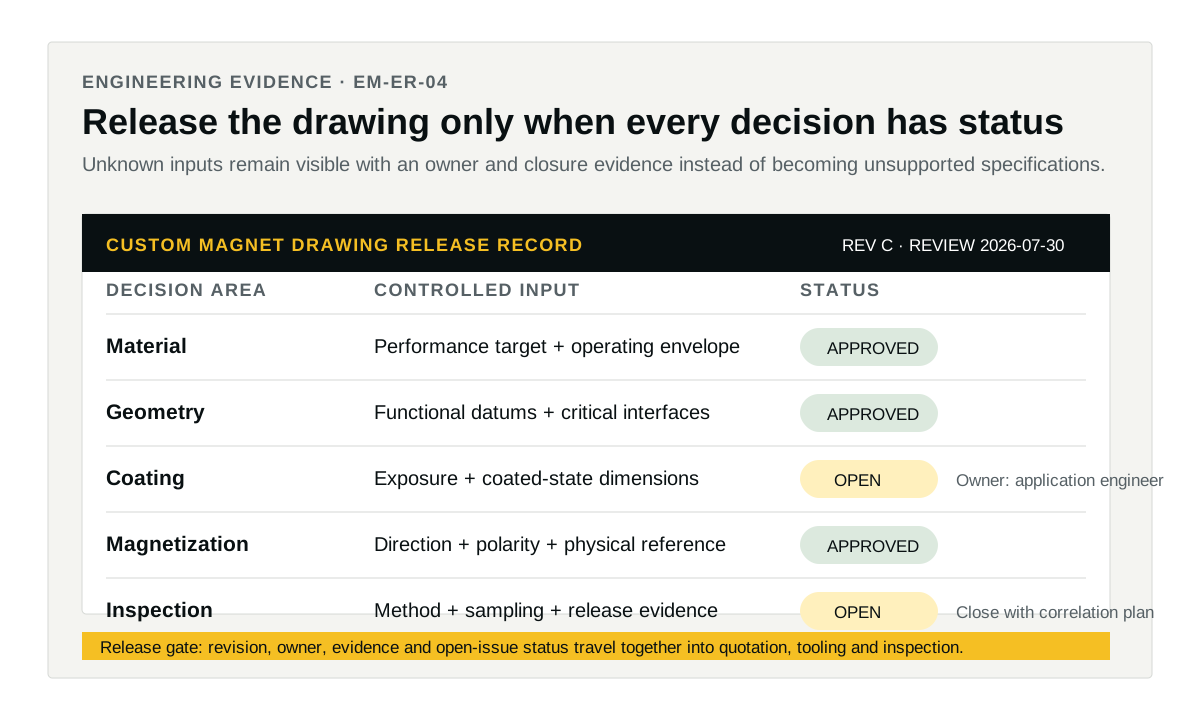
| Status | Required record | Release treatment |
|---|---|---|
| Approved | Controlled input, revision, reviewer, and supporting evidence | Use in quotation, tooling, sample, and inspection planning |
| Open | Question, owner, decision deadline, and evidence needed to close | Keep visible; do not convert it into an assumed specification |
| Not applicable | Reason the decision does not affect the selected route | Record the rationale to prevent later ambiguity |
| Changed | New revision and affected downstream decisions | Repeat DFM, quotation, tooling, validation, or inspection review as required |
Drawing review table
| Area | Include | Avoid |
|---|---|---|
| Material | Approved grade or required performance and operating envelope | Choosing the highest grade without circuit context |
| Geometry | Nominals, tolerances, functional datums, edge conditions, and critical interfaces | Tight general tolerances on every feature |
| Coating | Finish, coated-state dimensions, masking, appearance, and validation need | A coating name with no exposure or assembly context |
| Magnetization | Direction, polarity, pole map, physical reference, and delivery state | “Standard” or “north side” without a datum |
| Inspection | Critical characteristic, method, location, sampling, and evidence | Field or dimension values without a reproducible setup |
| Commercial | Prototype quantity, annual demand, target timing, and revision | Mixing prototype and production assumptions |
1. Material and magnetic performance
- Material family: sintered NdFeB, sintered SmCo, bonded magnet, or performance-led review.
- Grade and coercivity family when already approved.
- Field, force, torque, flux, or sensor target at a defined location.
- Continuous, peak, assembly, storage, and fault temperatures where relevant.
- External demagnetizing fields and allowable irreversible change.
2. Geometry, tolerances, and datums
- 2D controlled drawing and useful 3D model.
- Functional faces, bore, outside diameter, bond surface, air-gap surface, and assembly datum.
- Critical-to-function characteristics separated from non-critical dimensions.
- Holes, slots, thin walls, edges, chamfers, and fragile features.
- Geometric controls that reflect assembly, such as runout, flatness, parallelism, or pole position where required.
3. Coating and assembly
- Exposure, contamination, corrosion, appearance, and handling requirement.
- Whether dimensions apply before or after coating.
- Masking, bonding, adhesive, cure, press fit, sleeve, hub, overmolding, or housing details.
- Magnetized handling constraints and assembly sequence.
4. Magnetization
- Axial, diametrical, radial, through-thickness, or controlled multipole pattern.
- Polarity, pole count, pitch, sequence, viewing direction, and start reference where applicable.
- Mechanical reference for angular clocking or orientation marking.
- Magnetized or unmagnetized delivery state.
5. Inspection, evidence, and revision control
- Critical dimension and magnetic acceptance characteristics.
- Measurement location, air gap, orientation, fixture, and method.
- First-article, sample report, material evidence, coating evidence, or other required documentation.
- Drawing number, revision, units, scale, applicable standards, and conflict hierarchy.
- Owner and status of every open technical decision.
What to do when information is not yet known
Do not invent a grade, tolerance, coating, or test merely to make the drawing look complete. Mark the item “for engineering review,” then provide the product target, envelope, environment, assembly, quantity, and decision deadline. A visible open question is safer than a false requirement that becomes embedded in quotation and tooling.
Before sending the RFQ
- Remove obsolete files and identify the controlled revision.
- Check units, datums, coated state, and magnetization viewing direction.
- Mark critical features and explain their product function.
- List open decisions and the evidence needed to close them.
- Include prototype and expected production quantities separately.
- Use a secure agreed channel for confidential drawings.
Use the existing one-page RFQ checklist, compare magnet materials and product routes, review custom manufacturing capabilities and quality planning, or start with the RFQ form.
Engineering note: This checklist improves communication but does not replace project-specific DFM, material, fixture, inspection, commercial, or confidentiality review.

Frequently asked questions
What is the minimum information needed for a custom magnet RFQ?
Provide geometry, material intent or performance target, magnetization, coating, critical dimensions and datums, operating conditions, inspection requirements, prototype quantity, annual volume, and revision status.
Can a supplier quote accurately from a 3D model alone?
Usually not. A 3D model may define nominal geometry, but tolerances, magnetic orientation, coating, edge condition, inspection, quantity, and acceptance requirements still need controlled documentation.