



Magnetization direction basics
Axial Magnetization Explained for Discs, Cylinders and Rings
Direct answer: Axial magnetization means the primary magnetization direction runs through the part along its axis or thickness. For a disc, cylinder or ring, the two opposing axial faces are commonly described as the pole faces. “Axial” is a direction reference, not a guaranteed field, force, grade, temperature limit or supplier capability. A production drawing must still identify the physical datum, pole, viewing direction, delivery state, measurement position and acceptance rule.
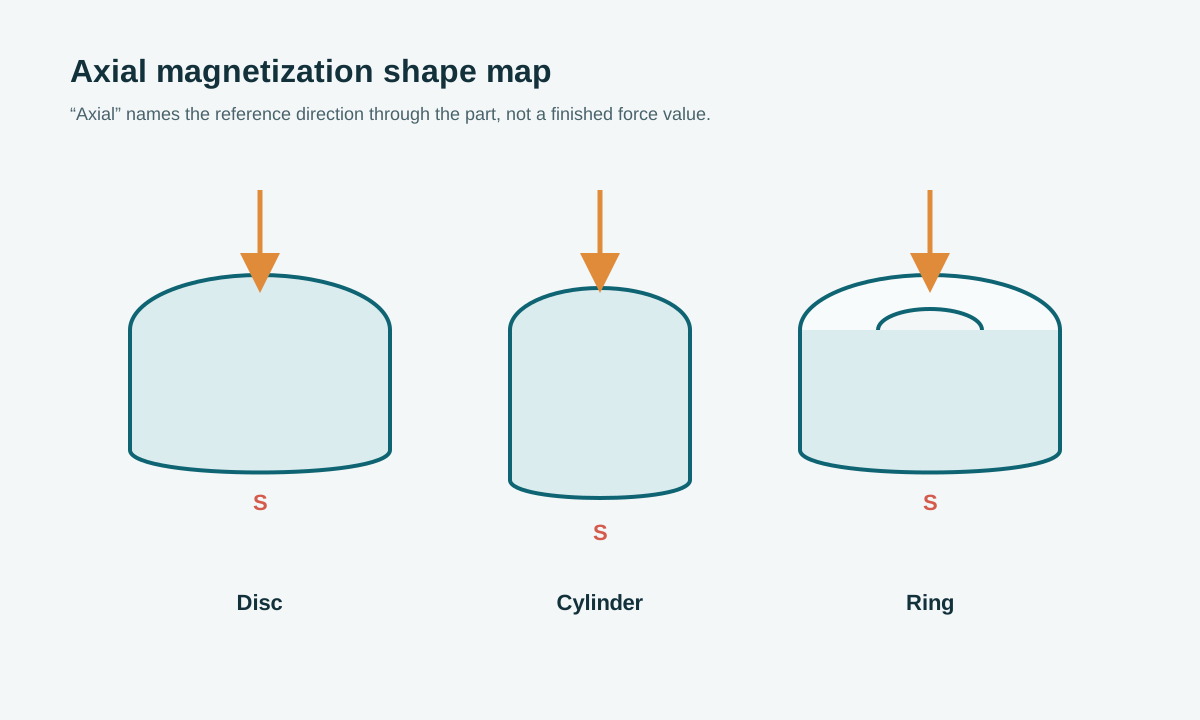
What “axial” means on a magnet
Axial describes the direction used to reference the magnetization through the axis or thickness of the part. On a disc or cylinder, the reference is normally from one circular face to the opposite face. On a ring, the same through-thickness direction can be used even though the part has a bore. The word does not define which face is N or S until the drawing or inspection instruction states it.
Axial direction is different from a complete specification
| Drawing layer | Minimum question | Why it matters |
|---|---|---|
| Direction | Which axis or thickness direction is intended? | Aligns the part with the circuit and fixture. |
| Polarity | Which physical face is N or S when viewed from the datum? | Prevents a correct direction from becoming a reversed assembly. |
| Assembly state | Is the part delivered magnetized, unmagnetized or magnetized after joining? | Changes handling, access, fixture and inspection planning. |
| Measurement | Where, at what distance and under which fixture is output checked? | Makes the acceptance result reproducible. |
| Pattern | Is the part single-pole-pair or does the assembly require another pattern? | Separates axial direction from diametrical, radial or multipole requirements. |
Axial, diametrical and radial: keep the reference visible
Axial, diametrical and radial describe different reference directions. A disc or cylinder may be axial or diametrical depending on the application. A ring may be axial, radial or multipole depending on the magnetic circuit and sensing geometry. Do not infer the required direction from shape alone; use the circuit, assembly datum and inspection path.

Connect axial magnetization to the working part
Useful performance depends on geometry, pole area, air gap, surrounding steel, operating temperature, grade and measurement condition. A stronger material label cannot repair a reversed pole or an undefined air gap. For a ring or cylinder used in a sensor or motor, also state the angular reference, shaft or housing relationship and whether the final assembly changes the field path.
Questions to answer before an RFQ
- Which face or axis is the physical reference?
- Which pole must face the mating component or sensor?
- Is the part single-pole-pair, diametrical, radial or multipole?
- Will it be inspected loose, bonded, overmolded or in the final assembly?
- What field, force, flux or sensing result is required at what position and temperature?
Continue with the magnetization direction guide, axial versus diametrical comparison, Quality, and the RFQ form.
Frequently asked questions
Does axial magnetization mean the magnet has a north face and a south face?
It describes the through-axis direction. The drawing or inspection record must still identify which physical face is N or S from the chosen datum.
Are all disc magnets axially magnetized?
No. A disc can be diametrically magnetized or used in another pattern. Shape alone does not release the direction.
Is axial magnetization the same as radial magnetization?
No. They use different physical references. Compare the circuit, assembly geometry and required sensor or field path before choosing.
Does axial magnetization define magnetic strength?
No. Strength depends on the material, geometry, circuit, air gap, temperature, pole area and measurement condition.
What should an axial magnet drawing show?
Show the reference axis, pole face, viewing direction, assembly or delivery state, measurement location, method and acceptance criterion.
Source and evidence boundary
Google results were used to map the definition and comparison language. Existing magnetization-direction references support the terminology and drawing-control framework; no supplier field value, fixture limit or capability claim was transferred.
Frequently asked questions
Does axial magnetization define which face is north?
It defines the through-axis direction. The drawing or inspection record must still identify the N/S face from the chosen physical datum.
Are all disc magnets axially magnetized?
No. A disc can be diametrically magnetized or use another pole pattern. Shape alone does not release the direction.
Is axial magnetization the same as radial magnetization?
No. They use different physical references. Compare the circuit, assembly geometry and required sensor or field path before choosing.
Does axial magnetization define magnetic strength?
No. Strength depends on the material, geometry, circuit, air gap, temperature, pole area and measurement condition.
What should an axial magnet drawing show?
Show the reference axis, pole face, viewing direction, assembly or delivery state, measurement location, method and acceptance criterion.