



Magnetization direction definition
Diametrical Magnetization Explained
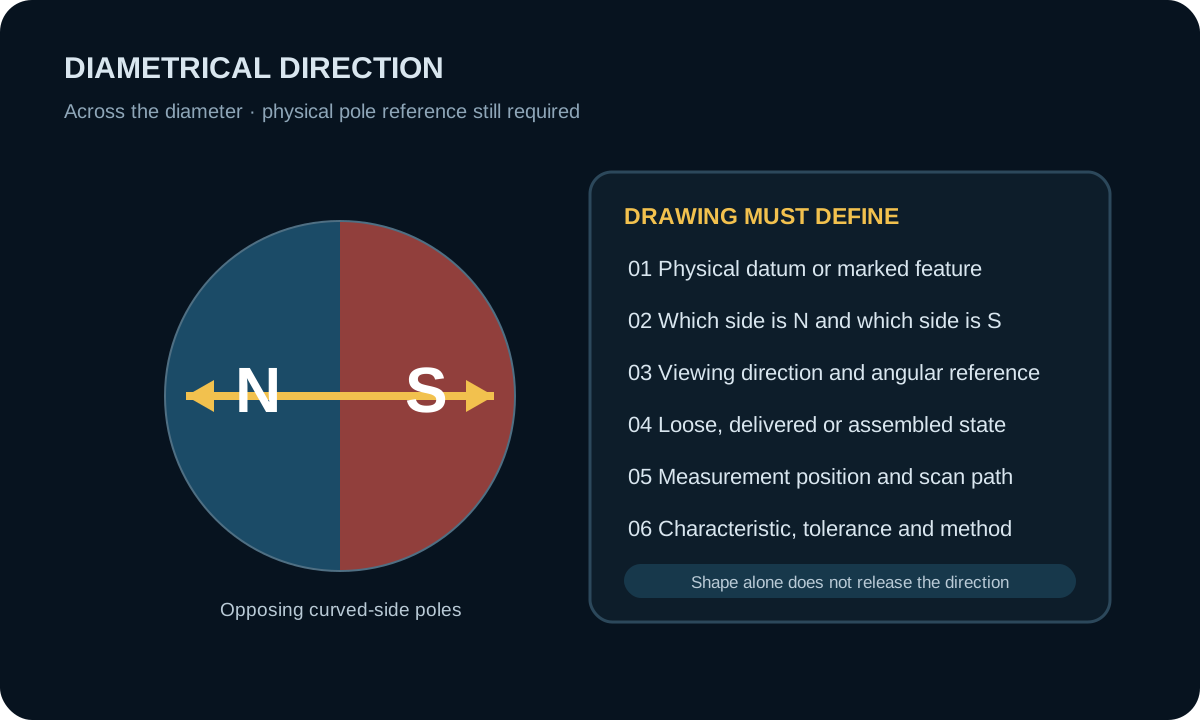
Direct answer: Diametrical magnetization runs across the diameter of a round disc, cylinder or ring, so the north and south poles are located on opposing curved sides. The term defines a direction, not the finished field strength or the identity of either physical pole. A controlled drawing must still name the datum, N/S side, viewing direction, part state and inspection path.
What diametrical magnetization means
Imagine a line passing through the center of a round magnet from one curved side to the opposite side. Diametrical magnetization uses that line as the primary direction. The two broad pole regions therefore appear across the side surface rather than on the two flat faces of an ordinary axially magnetized disc.
That definition applies to direction only. Material, dimensions, pole area, surrounding steel, air gap, temperature, magnetizing condition and the measurement setup still determine the useful magnetic result.
Complete the direction on the drawing
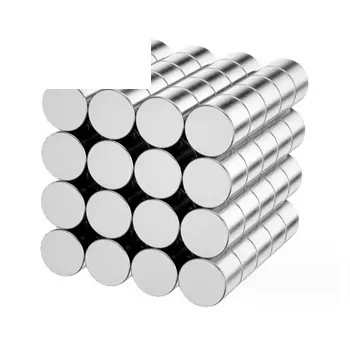
| Drawing field | What to define | Why it matters | Incomplete example |
|---|---|---|---|
| Physical datum | Named flat, slot, mark, key or angular feature | Links the magnetic direction to the manufactured part | “Across diameter” only |
| Polarity | Which referenced side is N and which is S | Prevents mirrored interpretation during assembly | Two unlabeled arrows |
| Viewing direction | The side from which the angular reference is read | Controls clockwise/counterclockwise meaning | Angle without a view |
| Part state | Loose, delivered, installed or fully assembled | The surrounding circuit can change the measured result | One value with no state |
| Inspection | Location, path, direction, fixture, method and limit | Makes the pole decision reproducible | “Check polarity” |

Where the direction can be useful
Diametrical orientation is often considered when a rotating part, side-facing sensor or lateral field path needs two opposing pole regions around the circumference. That is a screening reason, not a route approval. The final choice depends on the sensor position, air gap, steel circuit, required waveform or switching event, mechanical reference, assembly sequence and the feasible magnetization and inspection method.
If the design needs several alternating poles around a ring, the requirement is no longer described completely by “diametrical.” Pole count, sequence, pitch, start angle and scan path must be released as a multipole pattern.

Do not confuse diametrical, axial and radial
Axial magnetization follows the part axis or thickness. Diametrical magnetization crosses a round part from one curved side to the other. Radial terminology is commonly used for inward/outward directions in ring geometry and needs its own pole and surface definition. For a direct option comparison, use the axial versus diametrical guide; for the broader specification framework, use magnetization direction and pole patterns.
Inputs for engineering and quotation review
Send the controlled drawing or model, diameter and length or thickness, material intent, physical angular datum, N/S orientation, delivery and assembly state, sensor or working position, air gap and surrounding steel, temperature and environment, quantity, and the proposed inspection characteristic. Review bonded NdFeB routes, Quality, and the existing RFQ form for project-specific review.
Frequently asked questions
Where are the poles on a diametrically magnetized cylinder?
They are on opposing curved sides across the diameter. The drawing must still identify which referenced side is north and which is south.
Can a disc magnet be diametrically magnetized?
It can be a design option, but shape alone does not approve material, geometry, fixture, field result or inspection feasibility.
Is diametrical magnetization stronger than axial magnetization?
Neither direction is universally stronger. Useful output depends on the complete material, geometry, circuit, gap, temperature and measurement condition.
Is diametrical the same as radial magnetization?
No. Diametrical crosses a round part from side to side; radial terminology uses an inward/outward reference and requires a separate pole definition.
What should a diametrical magnet drawing show?
Show the physical datum, N/S side, viewing direction, angular reference, delivery or assembly state, measurement path, method and acceptance criterion.
Source and evidence boundary
The dated Google SERP and directly read seller education page were used for terminology and question coverage. No competitor product value, field output, fixture, equipment or manufacturing capability was adopted.
Frequently asked questions
Where are the poles on a diametrically magnetized cylinder?
They are on opposing curved sides across the diameter. The drawing must still identify which referenced side is north and which is south.
Can a disc magnet be diametrically magnetized?
It can be a design option, but shape alone does not approve material, geometry, fixture, field result or inspection feasibility.
Is diametrical magnetization stronger than axial magnetization?
Neither direction is universally stronger. Useful output depends on the complete material, geometry, circuit, gap, temperature and measurement condition.
Is diametrical the same as radial magnetization?
No. Diametrical crosses a round part from side to side; radial terminology uses an inward/outward reference and requires a separate pole definition.
What should a diametrical magnet drawing show?
Show the physical datum, N/S side, viewing direction, angular reference, delivery or assembly state, measurement path, method and acceptance criterion.